Posts

Essential facts about the Camino
Image
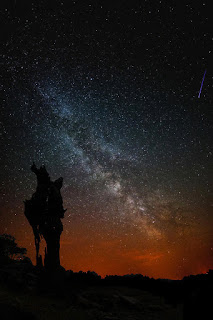
I am so grateful for the opportunity to hike the Camino de Santiago this summer. Here are answers to some common questions people have asked me.   What is the "Camino de Santiago"? Milky Way in Galicia, Spain. It was a pre-Christian route in the 8th century, then became one of the most important Christian pilgrim routes in the world during the Middle Ages (1100-1453AD).  The name Camino de Santiago comes from Saint James, an apostle of Jesus, who is supposedly buried in the Spanish city, Santiago de Compostela.  In Roman times, before St. James was buried there, people walked this route, following the Milky Way, to a town called "Finisterre" which was believed to be the end of the world. "El Camino de Santiago" means "The Way of Saint James" in English. It is also called "El Camino".  Why is the Camino de Santiago important?  During the Middle Ages (1100-1453 AD), it was one of three important Christian pilgri...

One step at a time

Image
I used to take walking for granted. Then, one year ago, I lost my ability to walk. It was soccer Sunday and I had played well all game, assisting several goals and playing solid defense. The sun had set over the mountains which meant I had only a few minutes left to score a goal before it got too dark to continue playing. A teammate passed me the ball and I dribbled down the field, until suddenly, it felt as if someone kicked my ankle. I collapsed.  At a doctor's appointment the next day, I was informed that I had a ruptured Achilles tendon and would need surgery. There was a long road ahead: after surgery, he said, I would be on bed rest for at least two weeks, out of work for about two months, not driving for several weeks after returning to work, in physical therapy for about a year, and might not be able to walk or dance at my wedding in three months. He explained that I might never regain 100% mobility of the joint but would probably come close.  It was a silly...

Welcome

In July 2019, I will  hike part of the Camino de Santiago, a UNESCO World Heritage Site in Spain. Along my journey, I will observe the rich cultural heritage of northern Spain as well as its natural beauty. I hope to explore questions around national and regional identities with pilgrims I meet on the trek and plan to share this experience with students through projects and activities that consider how identity is shaped by words, objects, places and the people we interact with.  Thank you to the Teacher's Travel Grant program at Curtis School for making this opportunity possible!